Interaction with Green Spaces
Interaction with nature and green spaces has wide and varied positive mental and physical health effects, with research suggesting that humans have ‘an innate affinity for the natural world’, and that contact with nature is fundamental to well-being and fulfilment (Wilson, 1984). The benefits of nature experiences are thought to include enhanced attentional and cognitive functioning (Kaplan & Kaplan, 1989, Hartig et al, 1991, Cimprich, 1990, cited in Wells, 2000, Hartig et al, 1991). The Natural Environment White Paper in England (DEFRA, 2011) and the independent government funded ‘Fair Society, Healthy Lives: The Marmot Review: strategic review of UK health inequalities since 2010’, both recognise the huge positive impact that nature and access to green spaces has on health.


Importance of Outdoor Play
Play is vital for a child’s development (e.g. Ginsburg et al, 2007), and natural play environments are particularly significant for the development of physical, social, emotional and cognitive skills and for the development of positive self image in relation to the environment and to others (e.g. Bento & Dias, 2017, Burdette & Whitaker, 2005, natural England). A natural environment presenting opportunities to engage in exciting ‘risky play’ can help children to work through fears, challenge themselves and enable them to develop vital motor and coping skills. This was proposed by Sandsetter & Kennair (2011) in their theoretical article considering the evolutionary benefits of risk taking for kids and supported by Ball et al (2008). Risky play is determined by Sandsetter as ‘thrilling and exciting forms of physical play that involve uncertainty and a risk of physical injury’ (Sandsetter, 2010) The inherent diversity and lack of structure in the outdoors environment provides natural opportunities to develop attention through focusing on problem solving through play.
Furthermore, outdoor play has been shown to improve attention in adolescents, improve physical and cognitive skills and reduce symptoms of ADD in children. Wilderness challenge experiences have been shown to encourage personal development, mindfulness, self efficacy and happiness in adolescents (Paquette and Vitaro, 2014 and Matz and Muller, 2016). Children in a day care centre with a natural outdoors setting incorporating orchards and woodland, who played outdoors irrespective of the weather, had better motor coordination and attentional concentration abilities than those in an urban setting with a playground surrounded by buildings (Grahn et al, 1997, cited in Wells, 2000) and Taylor et al (2001) found that children with attention deficit disorder (ADD) had reduced symptoms after playing in green spaces.


Qualitative research investigating disabled people’s use of woodlands found that they found these environments were beneficial physically and psychologically- for stimulating different senses, reconnecting with nature and helping to ‘get away from it all’. People with disabilities benefit from a sense of achievement when accessing the countryside and from extending their skills and achievement through outdoor challenges (Diversity review, 2005).
The decline of outdoor play
Despite all the strategies, policies and evidence showing the benefits of open-air experiences, children’s outdoors play has dramatically reduced in recent decades as documented by national surveys (BBC Press Office, 2008, England Marketing, 2009 and Henley, 2010).In the UK almost a third of children aged five to 12 play outside for just 30 minutes a day (Persil/Edelman Berland, 2016). Children from ethnic minorities, children with disabilities and girls are the least likely to play outdoors (Natural England, 2010). Authors including Louv (2005) have decried this tendency as potentially devastating, warning about the lack of future environmentalists resulting from this disconnect between children and the natural world, and Kahn (1997) foretells of a potential spiral of parents who were not introduced to the natural world as children, not providing those opportunities for their own children.
This reduction in outdoors play seems to have several causes. Television, computer games, a reduced number of local green spaces, families having limited budgets and a lack of perceived time to access natural environments, and the unwelcoming attitudes of society and the threat of ASBOs’ (Natural England, 2010) are all responsible. Adolescents are using the internet three times as much as they were doing a decade ago- girls primarily using social media; boys online gaming. Screen-time use tends to increase with age, and after the age of 15, 60% spend more than three hours daily looking at screens (Gabrielson and Harper, 2017), compared with ten minutes in an outdoor location (Office for National Statistics, 2018).


Parental fear is another primary cause of this reduction of outdoors play- a fear of strangers, injury, traffic and the unknown, meaning that children, and especially disabled children, are rarely allowed to play outside alone. Children need challenges and varied stimulation for normal physical and cognitive development, and by being sheltered from such opportunities children may become more fearful with increased levels of psychopathology (Sandseter and Kannair, 2011).
Research shows that learning disabled children often have access to additional opportunities to engage with outdoor spaces through therapeutic, specialist and supervised activities. However, rather than providing chances for these children to learn to engage with and feel confident in the natural environment such activities frequently appear to be highly structured and controlled, and involve the use of only man-made materials, with minimal or no opportunity for independent exploration. (von Benzon, 2011)
Supporting Outdoor Play
Various organisations and individuals are trying to reverse this trend, and to reintroduce youngsters into the natural environment. These offer supported opportunities for youths of various abilities to learn outdoor skills, ranging from woodland crafts and survival skills to extreme sports and wilderness therapy. Wild adventure space: its role in teenagers’ lives, a Natural England commissioned report, (2010) recommends that projects should be developed that are effective at engaging young people with disabilities with wild adventure spaces. It stresses that what is considered wild and adventurous will vary between different ages and cultures, and so it is important for a variety of activities to be available.


Forest School is a nationwide programme with trained practitioners who provide opportunities for engaging with the natural world, in a series of regular sessions usually within a woodland setting. Each session is learner centred and allows for deep level learning and supported risks, and are intended to improve resilience, confidence and creativity. (Forest school association, n.d.) They also offer more targeted sessions for people with learning disabilities and social problems. Research suggests such activities can have a range of positive impacts, particularly in regard to building ‘confidence, social skills,
language and communication, motivation and concentration, physical skills and knowledge and understanding’ (O’ Brien and Murray, 2007:249).
Outdoor adventure learning involves collaborative outdoor learning experiences which incorporate physical and emotional challenges and is often used as a form of nature-based therapy. This is defined as the use of activities and experiences with the natural environment to gain healing. Practical problem solving, and discussion of emotion are often incorporated, and is effective in improving social interaction and communication in children with and without disabilities (Zachor et al, 2016).
One way of structuring outdoor experiences is to use Flow Learning (Cornell, 2015). It is a four-stage process designed to enhance connection with the environment and learning. The stages are: awaken enthusiasm, focus attention, offer direct experience and share inspiration. Each stage flows naturally from the previous and uses games to capture the imagination. Qualities and benefits of each stage are given in the Appendix below.

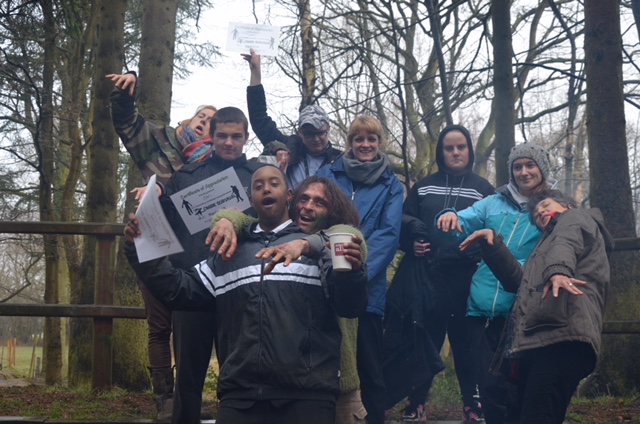
This intervention combines these ideas: from Forest School we incorporate the ideas of a high adult:child ratio; exploring and playing in the natural environment, whatever the weather, on a weekly basis; using nature based practical activities, incorporating the use of sharp tools when appropriate and safe; and fire building. From outdoor adventure learning we incorporate the idea of collaborative learning experiences, physical challenges and problem solving, with no formal academic component. The sessions are loosely based around the four stage Flow Learning process described above. All share the benefits of exploring and experiencing the outdoor environment.
Zombie Survival has been developed from a combination of these ideas to engage and inspire youths; to encourage them to interact with nature and to feel comfortable playing in an outdoor environment; to overcome fears and uncertainty and to communicate and interact with each other as they work together learning survival and team building skills.
References
Ball, D., Gill, T., and Spiegal, B. (2008) Managing risk in play provision: Implementation guide. London: National Children’s Bureau
Bento, G., and Dias, G. (2017) ‘The importance of outdoor play for young children’s healthy development’. Porto Biomedical Journal 2(5):157–160
Burdette, H.L., and Whitaker, R.C. (2005) ‘Resurrecting Free Play in Young Children Looking Beyond Fitness and Fatness to Attention, Affiliation, and Affect’ (Reprinted) Archives of Pediatric & Adolescent Medicine 159:46-50
Cornell, J. (2015) Deep Nature Play California: Crystal Clarity Publishers.
Department of Environment Farming and Rural Affairs (2011) Natural choice: Securing the value of nature [white paper] London: Stationery Office (Cm 8082)
Forest School Association (n.d.) What Is Forest School? [online] available from <http://www.forestschoolassociation.org/what-is-forest-school/> [8 April 2018]
Gabrielson, L. E., and Harper, N.J. (2017) ‘The role of wilderness therapy for adolescents in the face of global trends of urbanization and technification’ International Journal of Adolescence and Youth
Henley, J., (2010) ‘Why our children need to get outside and engage with nature’ The Guardian [online] 16 August. available from <http://www.guardian.co.uk/lifeandstyle/2010/aug/16/childre-nature-outside-play-health> [21 March 2018]
Kahn, P. (1997) ‘Developmental psychology and the Biophilia Hypothesis: Children’s affiliation with Nature’ Developmental review, 17:1-61.
Kaplan & Kaplan (1989) The Experience of Nature: A psychological perspective. New York: Cambridge University Press.
Louv, R. (2005) Last child in the woods. Chapel Hill, North Carolina: Algonquin Books of Chapel Hill.
Marmot, M. (2010) Fair society, healthy lives : the Marmot Review : strategic review of health inequalities in England post-2010. University College London: London
Mutz, M., & Müller, J. (2016) ‘Mental health benefits of outdoor adventure: Results from two pilot studies’. Journal of Adolescence 49, 105–114
Natural England (2005) “What about us?”: Diversity Review evidence – part one Challenging perceptions: under-represented visitor needs [white paper] London: Stationery Office (CRN94)
Natural England (2009) Report to Natural England on childhood and nature: a survey on changing relationships with nature across generations [online] available from <http://publications.naturalengland.org.uk/file/5495287317528576> [9 April 2018]
Natural England, (2010) Wild adventure space: its role in teenagers’ lives a natural England commissioned report NECR025 Natural England: Sheffield
O’ Brien, L., Murray, R. (2007) ‘Forest School and its impacts on young children: Case studies in Britain’ Urban Forestry and Urban Greening (6) 249-265
Office for National Statistics (2018) Childrens Engagement With the Outdoors and Sports Activities UK 2014 to 2015 [online] available from <https://www.ons.gov.uk/peoplepopulationandcommunity/wellbeing/articles/childrensengagementwiththeoutdoorsandsportsactivitiesuk/2014to2015> [15 April 2018]
Paquette, J., & Vitaro, F. (2014) ‘Wilderness therapy, interpersonal skills and accomplishment motivation: Impact and analysis on antisocial behavior and socio-professional status’. Residential Treatment for Children and Youth, 31(3), 230–252
Persil/ Edelman Barland (2016) Dirt is good: the campaign for play. [online] available from < www.dirtisgood.com/uk/truth-about-dirt.html> [19 April 2018]
Pretty, J., Griffin, M., Peacock, J., Hine, R., Sellens, M., & South, N. (2005) A countryside for health and well-being: The physical and mental health benefits of green exercise. Essex: University of Essex
Sandseter, E. B. H. (2010) Scaryfunny – A qualitative study of risky play among preschool children [online] PhD thesis. Norwegian University of Science and Technology. available from <https://brage.bibsys.no/xmlui/bitstream/handle/11250/270413/322544_FULLTEXT02.pdf?sequence=1&isAllowed=y> [15 April 2018]
Sandseter, B.E.H., Kennair, L.E.O. (2011) ‘Children’s Risky Play from an Evolutionary Perspective: The Anti-Phobic Effects of Thrilling Experiences Evolutionary Psychology’. Evolutionary Psychology Journal 9(2), 257-284
Taylor, A. F., Kuo, F. E., Sullivan, W.C., (2001) ‘Coping with ADD The Surprising Connection to Green Play Settings’ Environment and Behavior, 33(1), 54-77
Wells, N.M. (2000) ‘At home with nature: Effects of “greenness” on children’s cognitive functioning’. Environment and Behavior 32, 775–795.
Wilson, E.O. (1984) Biophilia Harvard Univ. Press, Cambridge, MA
Wray, C. (2008) ‘Environment at risk if children don’t play ‘wild’’ BBC Press Office [online]31 July. available from <http://www.bbc.co.uk/pressoffice/bbcworldwide/worldwidestories/pressreleases/2008/07_july/bbcwildlife_wild_survey.shtml> [11 April 2018]
Zachor, D. A., Vardi, S., Baron-Eitan, S., Brodai-Meir, I., Ginossar, N. and Ben-Itzchak, E. (2017) ‘The effectiveness of an outdoor adventure programme for young children with autism spectrum disorder: a controlled study’. Developmental Medicine & Child Neurology 59, 550-556